Guide
How to play 8-ball
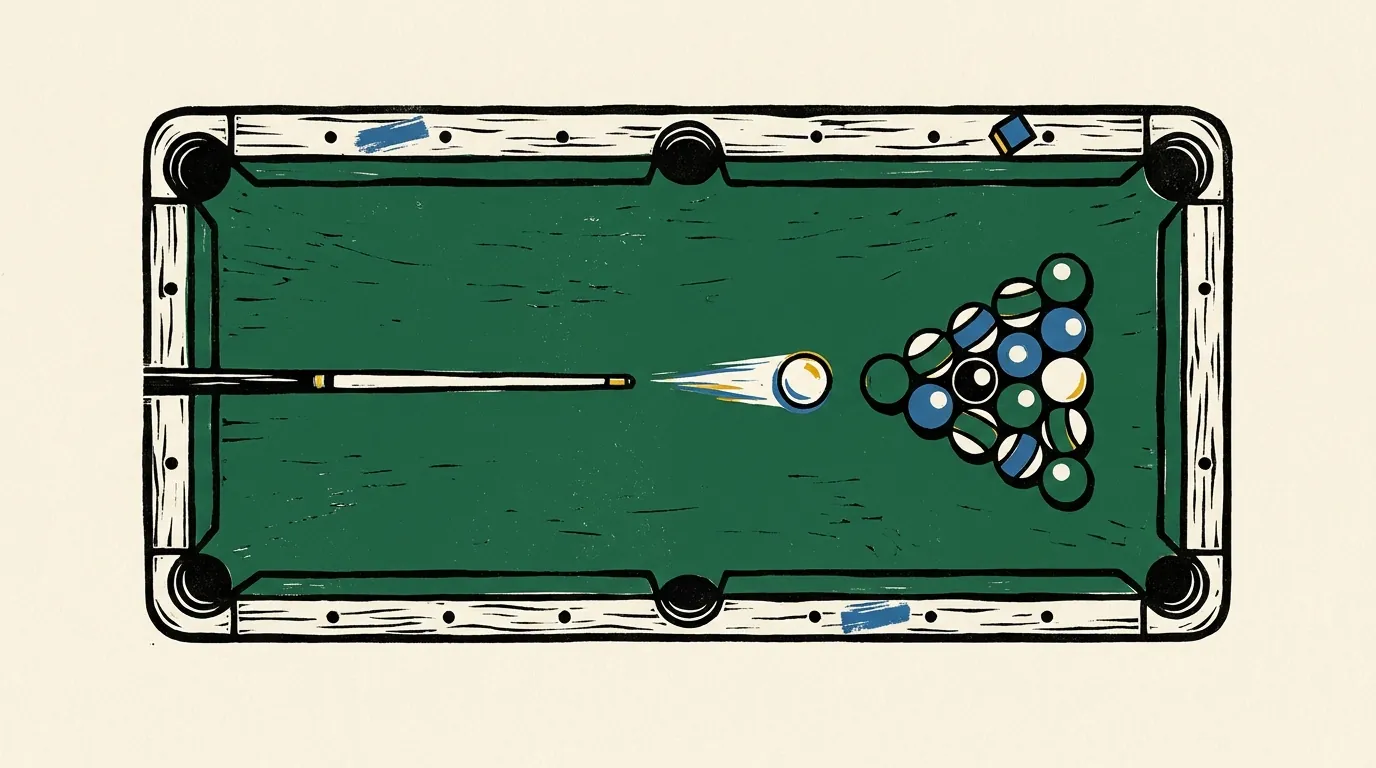
8-ball is the game most people mean when they say "let's shoot some pool." It's played with a white cue ball and fifteen numbered balls. One player takes the solids (1 through 7), the other takes the stripes (9 through 15). Pocket all of your group, then pocket the 8-ball, and you win.
The basics are the same almost everywhere. The details are not. A bar, a pool hall and a league can each play the break, the scratch and the 8-ball a little differently, and every league has its own rulebook. This guide covers the rules most rulebooks share and points out where they tend to differ. Before you play someone new, take ten seconds to agree on the rules.
What you need
- A table. Bars usually have 7-foot tables. Pool halls often have 8- and 9-foot tables too. See pool table sizes.
- A full set of balls: the cue ball, seven solids, seven stripes and the black 8-ball.
- A triangle rack, cues and chalk. If you're using a house cue, here's how to pick a straight one.
Racking the balls
Set the triangle on the far end of the table so the front ball, the apex, sits on the foot spot. Then:
- Put the 8-ball in the middle of the third row, the center of the rack.
- Put one solid in one back corner and one stripe in the other back corner.
- Fill the rest in any order.
Push the balls forward and press them together so every ball touches its neighbors, then lift the rack straight up. A loose rack, with gaps between balls, makes the break weaker and less predictable. Who racks is a matter of custom. In many bar games the player who lost the last game racks for the winner; leagues and tournaments set their own rule.
The break
The breaker places the cue ball anywhere behind the head string, the imaginary line across the table through the second diamond from the end you break from. The area behind it is called the kitchen.
Under most rules, a legal break has to either pocket a ball or drive at least four object balls to a cushion. If the break isn't legal, the other player usually gets to choose: play the table as it lies, or re-rack and break (or have you break again). Bar rules are often looser.
Some situations on the break vary a lot from one set of rules to another:
- A scratch on the break (the cue ball goes in a pocket) is a foul. Depending on the rules, the other player gets ball in hand behind the head string or anywhere on the table.
- The 8-ball on the break is a win in some rulebooks, a re-rack in others, and in others the 8 is put back on the foot spot and play goes on. If the breaker also scratches, some rules call it a loss.
Agree on these two before the first break and you'll avoid most arguments.
Open table: choosing solids or stripes
Right after the break the table is "open." Neither player owns a group yet, even if balls went in on the break. Under most standard rules, you claim a group by calling and pocketing a ball after the break. Make a called stripe and you have the stripes.
While the table is open you may hit a solid first to pocket a stripe, or the other way around. Once groups are set, every shot has to hit a ball from your own group first.
Many bars play a simpler version: whatever goes in on the break decides the groups, or the first ball made after the break does, called or not. That's a house rule. Ask.
Calling your shots
In standard 8-ball you call the ball and the pocket for every shot that isn't obvious. You don't have to name every cushion or kiss, just which ball goes in which pocket. Bank shots, kick shots and combinations should always be called.
- If the called ball goes in the called pocket, you keep shooting.
- If it doesn't, your turn ends, even if a different ball dropped.
- Extra balls that fall on a legal shot stay down. In most rules, a ball of your opponent's that drops by accident counts for them, not against you.
Some bar games play "slop," where anything that falls counts. Others make you call only the 8-ball. Again: ask first.
What makes a legal shot
Every shot has two requirements. First, the cue ball must hit a ball of your group before anything else (on an open table, any solid or stripe). Second, after that contact, either a ball must go in a pocket or some ball, the cue ball or any object ball, must hit a cushion. A shot that does neither is a foul.
That second rule is what keeps safety play honest. You can roll up softly behind a ball to hide the cue ball, but something has to reach a rail.
Common fouls
- Scratching: the cue ball goes in a pocket.
- The cue ball leaves the table.
- Wrong ball first: the cue ball hits your opponent's group or the 8-ball first (unless the 8 is your legal target), or hits nothing at all.
- No rail after contact: nothing is pocketed and no ball touches a cushion after the cue ball hits your ball.
- Touching balls: moving any ball with your hand, clothes, the chalk or the cue, other than the normal stroke of the cue ball.
- Double hit or push: the cue tip stays on the cue ball or hits it twice in one stroke. This often happens when the cue ball is very close to the ball you're shooting at.
- No foot on the floor while shooting. Most rules require at least one foot touching the floor.
- Shooting while a ball is still moving or spinning.
Ball in hand
After a foul, the incoming player gets ball in hand: they pick up the cue ball and place it anywhere on the table before shooting. That's a big advantage, which is why fouls matter so much in 8-ball.
Not every game plays it that way. Some bar rules and some leagues give ball in hand only behind the head string after a scratch, or play "two shots" instead. When the cue ball must go behind the head string, you usually can't shoot directly at a ball that's also behind the line.
Shooting the 8-ball
Once your group is cleared, the 8-ball is your target. Always call the pocket for the 8, even if the shot looks obvious. You win when you legally pocket the 8 in the called pocket.
You lose the game if you:
- pocket the 8 before you've cleared your group;
- pocket the 8 in a pocket you didn't call;
- knock the 8 off the table;
- scratch or foul on the same shot that pockets the 8.
What happens when you scratch while shooting at the 8 but the 8 doesn't drop is another common split. Standard rulebooks treat it as an ordinary foul, so your opponent gets ball in hand. Many bars and some leagues count it as a loss.
House rules and league rules. Every league publishes its own rulebook, and league nights follow that book, not the bar's habits. If you're joining a league, read its 8-ball rules before your first match. Places whose reviews or website mention leagues are listed on our pool leagues page.
A few habits that help new players
- Look at the whole table before your first shot. Find the balls in your group that can't be pocketed yet, and think about which ones you'll need to move.
- Don't rush to make balls. Running out half your group and leaving the rest blocked often gives your opponent an easy table.
- Plan for the 8. Leave one of your balls near the 8 so you have a way to get position on it at the end.
- Learn one safety. When you don't have a good shot, rolling the cue ball behind one of your own balls, while still reaching a rail, can win more games than a low-odds shot.
When you're comfortable with 8-ball, try 9-ball, which uses fewer balls and plays very differently. And when you head out to play, read up on pool hall etiquette first.
 9-ball rules
 Pool hall etiquette
 How to join a pool league