Guide
9-ball rules
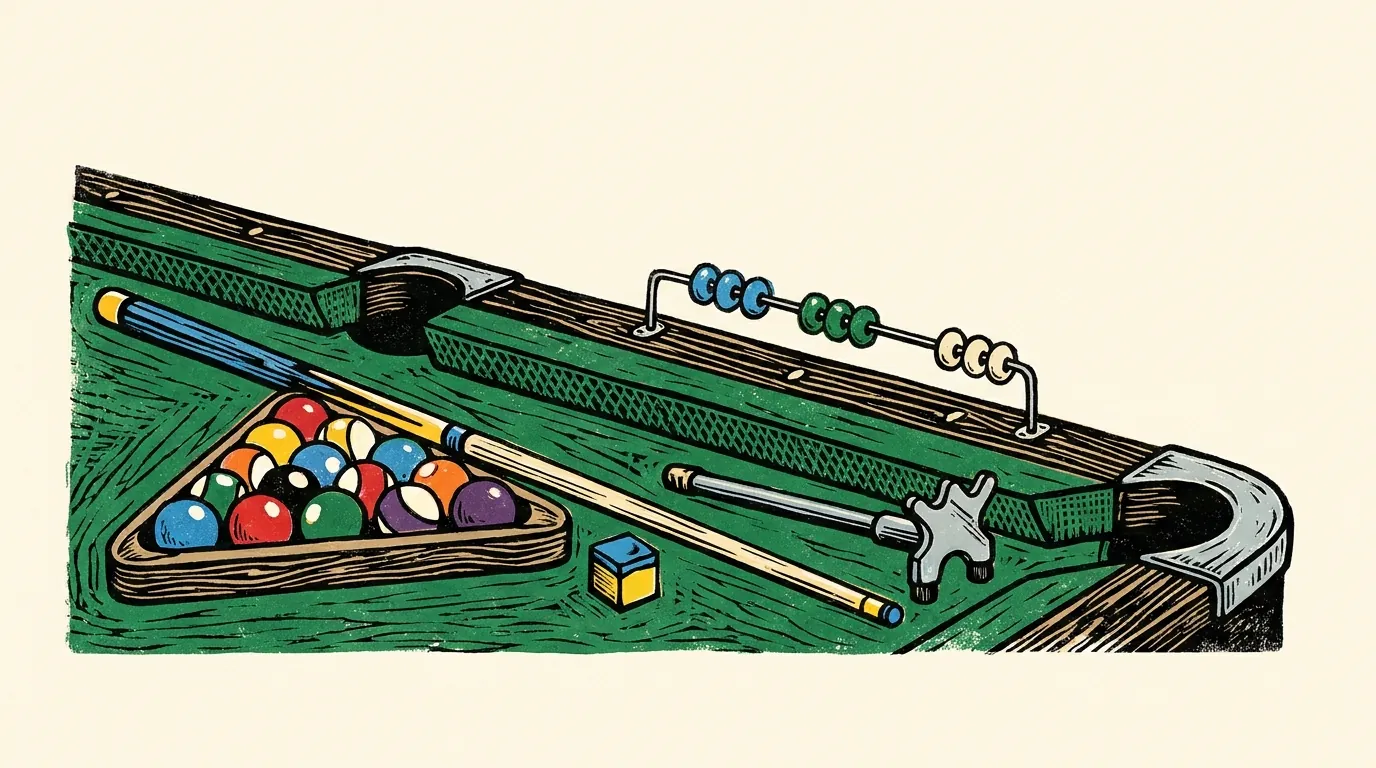
9-ball is a fast game played with the cue ball and the balls numbered 1 through 9. There are no solids or stripes, and in the standard game you don't call your shots. There is one rule that shapes everything else: on every shot, the cue ball must hit the lowest-numbered ball on the table first. Whoever legally pockets the 9-ball wins the rack.
Because it rewards cue ball control and runs quickly, 9-ball is a common game in pool hall tournaments and pro events. This guide covers the rules most rulebooks share. Leagues and tournaments publish their own versions, so check the one you're playing under.
The rack
9-ball uses a diamond-shaped rack: rows of one, two, three, two and one ball. You can use a diamond rack or a regular triangle with the back rows left empty.
- The 1-ball goes at the front, on the foot spot.
- The 9-ball goes in the middle of the diamond.
- The other balls go anywhere else.
As in 8-ball, rack tight. Every ball should touch its neighbors. Some events use templates (thin sheets that hold the balls in place) or have players rack for themselves. If you're playing a stranger for the first time, agree on who racks.
The break
The breaker shoots from behind the head string, the line through the second diamond at the near end of the table. Under common standard rules, the break must hit the 1-ball first and then either pocket a ball or drive at least four object balls to a cushion. A break that doesn't do that is a foul.
If the 9-ball goes in on a legal break, the breaker wins the game on the spot. Many tournaments add their own break rules, for example where the cue ball must be placed or how many balls must pass the middle of the table. Those are event rules, not part of the basic game.
Hit the lowest ball first
This is the heart of 9-ball. Before every shot, find the lowest-numbered ball still on the table. The cue ball has to touch that ball before it touches anything else.
After that first contact, anything goes. Any ball that drops on a legal shot counts, and you keep shooting. If you hit the 2-ball first and it knocks the 9 into a pocket, you win. That's why combination and carom shots on the 9 are such a big part of the game.
As in 8-ball, every legal shot also needs one more thing after the first contact: a ball must go in a pocket, or some ball must hit a cushion. Otherwise it's a foul.
The push-out
The push-out exists because the break is so random. On the first shot right after a legal break, the shooter may announce a push-out. On that shot the cue ball doesn't have to hit the lowest ball, or any ball, and nothing has to reach a rail. You simply move the cue ball to a spot you like better. All other fouls, like scratching, still count.
Then the other player decides: take the shot from where the cue ball now sits, or hand it back and make you shoot from there. So the skill is to push to a position that's awkward for both players, or that looks better than it is.
- You must say "push-out" before you shoot. If you don't, it's a normal shot.
- Only the first shot after the break can be a push-out.
- Balls (other than the 9) pocketed on a push-out stay down. A 9 pocketed on a push-out is put back on the foot spot.
Many bar games skip the push-out entirely. League rules on it differ too.
Fouls
- The cue ball doesn't hit the lowest-numbered ball first, or hits nothing.
- Nothing is pocketed and no ball reaches a cushion after contact.
- The cue ball goes in a pocket (a scratch) or off the table.
- You touch or move a ball with your hand, clothes or the cue, other than the normal stroke.
- The cue tip hits the cue ball twice or pushes it.
- You shoot without a foot on the floor, or while balls are still moving.
The penalty is ball in hand: the other player places the cue ball anywhere on the table. Balls you pocketed on the foul stay down, except the 9. If the 9 goes in on a foul, or is knocked off the table, it's put back on the foot spot and play continues. You don't lose for pocketing the 9 on a foul; you just don't win with it.
The three-foul rule
Many rulebooks say that a player who fouls on three shots in a row, without a legal shot in between, loses the game. To be fair, the opponent usually has to warn the player after the second foul. This rule stops a player from fouling over and over on purpose to keep giving up ball in hand while leaving tough shots. Casual games often ignore it, so agree on it beforehand.
Safeties in 9-ball
Since you have to hit the lowest ball, a good safety leaves your opponent with no clear path to it. If they can't see the ball they must hit, they have to kick (bounce the cue ball off a rail) or jump, and a miss gives you ball in hand. Good 9-ball players think about safeties as much as shots.
A safety still has to be a legal shot: hit the lowest ball first, then get a ball to a rail. Some halls don't allow jump shots with house cues, since a bad jump can damage the cloth. Ask at the counter.
Common variations
- Call shot 9-ball. Some rules require you to call the pocket, at least for the 9.
- Points instead of racks. Some leagues score 9-ball by points for each ball pocketed instead of by racks won, with a handicap setting how many points each player needs.
- 10-ball. A close cousin played with balls 1 through 10, where shots are called. It's meant to reduce luck.
- Who breaks. Some games use winner breaks, others alternate breaks. Agree on it before the first rack.
Where to play. Many players prefer 9-ball on a full-size table. Our 9-foot tables page lists places whose reviews or website mention them, and tournaments lists places that hold them. Each listing shows the review sentence or website note behind the claim.
New to pool altogether? Start with how to play 8-ball, then come back to 9-ball. And if you want regular games against people at your level, read how to join a pool league.
 How to play 8-ball
 How to join a pool league
 Pool table sizes