Guide
How to choose a house cue
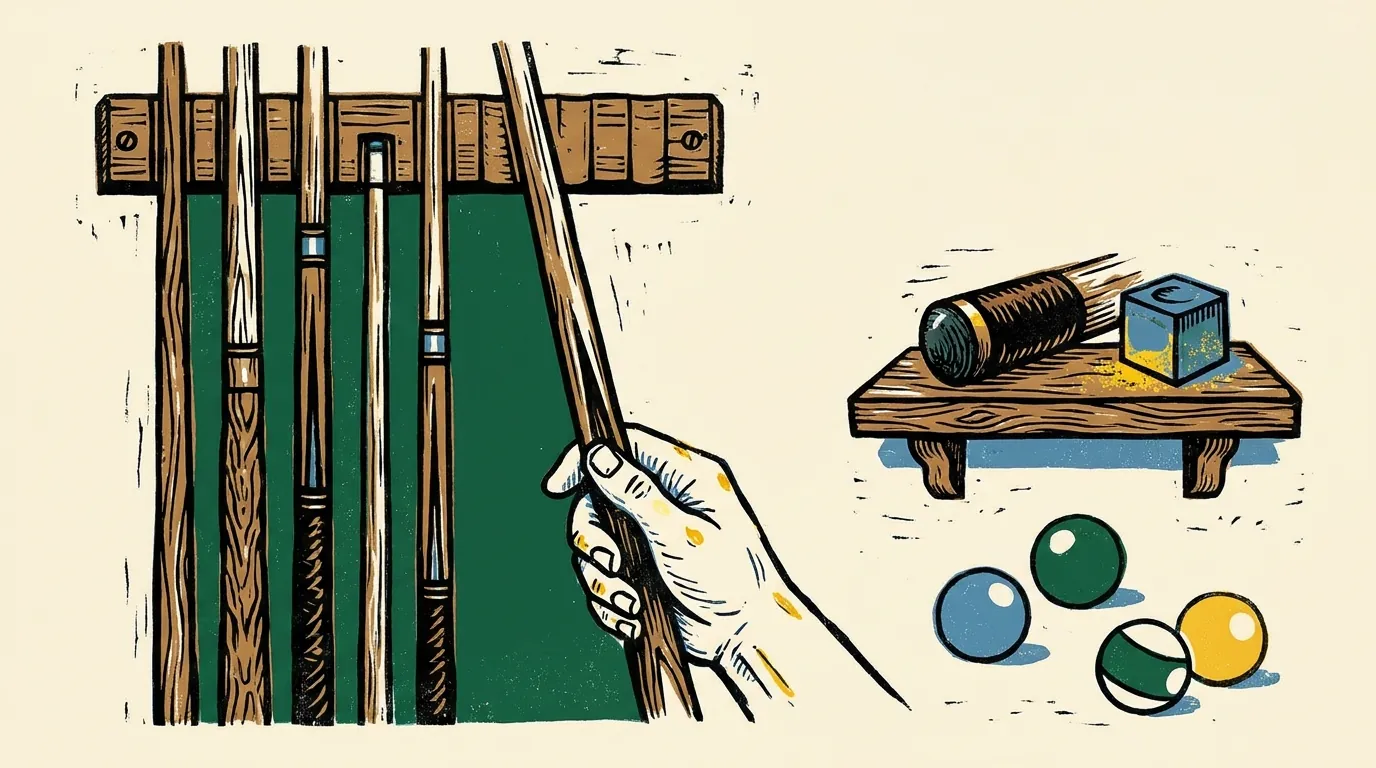
Every pool hall and most bars keep a rack of house cues on the wall. They get used every night by everyone, so some are in good shape and some are not. A bad house cue can make you miss shots you'd otherwise make, and you'll blame yourself. Taking a minute to pick a good one is worth it.
Here's what to check, in order.
1. Read the weight
Most house cues have their weight in ounces stamped or printed near the butt end. Racks often hold a range, from light to heavy. Lighter cues are easier to swing fast and make it easier to put spin on the ball. Heavier cues feel more solid and stable, and some players like one for breaking.
There's no correct weight. If you don't know what you like, start with one from the middle of the range on the rack, play a few shots, and try one lighter or heavier if it feels off. Once you find a weight you like, look for that number every time.
2. Check that it's straight
House cues warp. They get leaned against walls, left near heaters and dropped. A warped cue sends the cue ball slightly off line even when your stroke is good.
The roll test
- Lay the cue flat on the table bed, across the cloth. The table surface is level, so it makes a good test.
- Roll it gently away from you with your fingertips.
- Watch the gap between the cue and the cloth, especially near the tip. A straight cue rolls smoothly and stays flat. A warped cue wobbles, hops, or shows a gap that opens and closes as it turns.
Don't roll a cue along the top of the rail. Rails aren't flat enough to tell you anything. And remember that the butt of a cue tapers, so a bit of a gap toward the thick end is normal; what you're watching for is movement as it rolls.
The sight test
Hold the cue by the butt, point the tip away from you, and look down the shaft like a rifle barrel while you slowly turn it. If the tip seems to trace a small circle, the cue is bent. This is a quick check while you're still standing at the rack.
If a cue fails either test, put it back and try another. Most racks have at least one straight cue.
3. Look at the tip
The tip is the leather pad at the end of the cue, and it does more for your shot than anything else on the cue. Check for:
- Shape. A good tip is gently rounded, like the curve of a coin's edge. A flat tip makes miscues more likely when you hit off-center.
- Mushrooming. If the leather has spread out past the edge of the cue, it will catch and deflect. Avoid it.
- A shiny, hard surface. A glazed tip won't hold chalk and tends to slip off the cue ball. A slightly rough tip that takes chalk is what you want.
- Missing or loose tips. If the tip is coming off, or gone, it's not a usable cue. Let the counter know.
Also look at the ferrule, the white band just below the tip. A cracked or split ferrule can make the tip come loose mid-game.
4. Feel the shaft
Slide your bridge hand along the front part of the shaft. It should glide smoothly. A sticky or gritty shaft drags across your fingers and spoils your stroke. Dents and nicks catch on your hand too.
If a shaft is a little sticky, wipe it with a dry cloth or paper towel. Don't use water, drinks or anything wet on the wood. Shaft thickness also varies; house cues are often a bit thicker at the tip than many players' own cues. If one feels too thick or too thin in your bridge, try another.
5. Check the length and the grip
Most house cues are full length, around 57 to 58 inches. Many rooms also keep a few shorter cues for shots near a wall or for kids. If your stroke hits a wall or a post, ask for a short cue rather than chopping at the ball.
Look at the grip area too. A wrap that is torn or slick can slide in your hand.
Chalk, and caring for the cue while you have it
- Chalk before most shots, especially before you put spin on the ball. Brush the chalk across the tip lightly; don't grind it.
- Don't lean the cue against the wall or the table between shots. Hold it, or put it back in the rack.
- Return it to the rack when you leave. See pool hall etiquette for the rest of the shared-table habits.
When a cue of your own makes sense
There's nothing wrong with house cues. Plenty of good players use them. But a cue of your own starts to make sense when:
- You play every week, and you're tired of hunting for a straight cue with a decent tip.
- You join a league or start playing tournaments. Using the same cue every time, with the same weight, tip and feel, makes your game more consistent. Read how to join a pool league.
- You've found what you like. If you always reach for the same weight and tip shape, you know what to look for in your own cue.
Most personal cues are two-piece, so they break down to fit a case. A case protects the cue from knocks and from heat and damp, which cause warping. Don't leave a cue in a hot car.
Tips wear out and need replacing. Many pool halls have a pro shop or a staff member who does tips and repairs. Our pro shop and cue repair page lists places whose reviews or website say they do, with the proof shown for each. It's also a good place to try cues before you choose one.
Short version. Pick a weight you like, roll the cue on the table, look for a rounded tip that holds chalk, and make sure the shaft slides smoothly through your fingers. If it fails any of those, take another one.
 Pool hall etiquette
 How to join a pool league
 How to play 8-ball